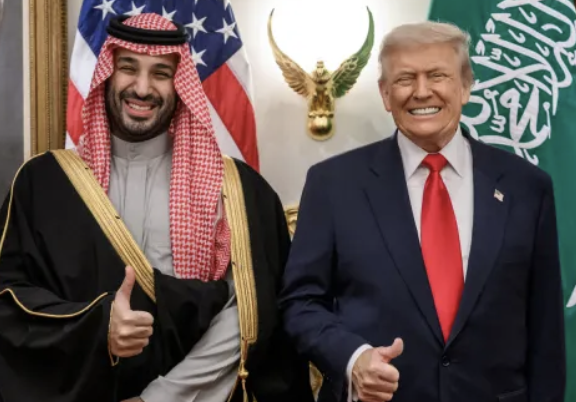
In the crisp air of a Washington November, President Trump welcomed Crown Prince Mohammed bin Salman to the White House on the 18th, a gathering that carried the weight of history and the promise of fresh alliances. It was a moment that echoed the old rhythms of diplomacy, where leaders meet not just as representatives of nations but as architects of a shared future. Trump, ever the dealmaker, sat across from the young prince, and in their conversations, one could sense the turning of a page—a reaffirmation of ties that have long bound America to the sands of Arabia, now infused with the vigor of an America First vision.
This encounter, marked by pageantry and purpose, came at a time when the world feels both smaller and more fractious. Horses processed, music swelled, and jets streaked overhead, symbols of respect for a partner whose kingdom holds keys to energy, security, and stability. Yet beneath the ceremony lay the substance: agreements signed, investments pledged, and a mutual understanding that in a turbulent globe, strong partnerships are not luxuries but necessities.
The world doesn’t know it yet, but the relationship between Trump and MBS will be remembered as the alliance that changed the world.
Think sword dance 2017.
A month after Trump’s visit, King Salman rescinded the Crown from Muhammad bin Nayef, in favor of MBS.
This led to the… pic.twitter.com/YBZWPDQXDo
— Clandestine (@WarClandestine) November 18, 2025
The Crown Prince’s Position and Offerings
Mohammed bin Salman arrives in America with a legal standing fortified by recognition of his role as prime minister, granting him immunity from lawsuits in U.S. courts—a status affirmed in 2022 and enduring today. This shield, rooted in the traditions of sovereign protection, allows him to engage without the shadows of past controversies dimming the dialogue. It is a pragmatic acknowledgment that leaders, in their official capacities, must sometimes navigate beyond personal reckonings to serve broader imperatives.
What he brings to the table is no small measure: a pledge of one trillion dollars in investments, flowing into American shores like an oasis spring. This includes deals on advanced fighter jets, such as the F-35, and civil nuclear cooperation, alongside chips and technology that bolster U.S. innovation. As head of a nation rich in oil and ambition, he offers not just resources but a vision—transforming Saudi Arabia from a petro-state into a hub of diversification, with funds that can fuel American jobs, infrastructure, and growth. In Trump’s orbit, this is the essence of reciprocity: a partner who invests in us as we secure their horizons.
The Immense Strategic Weight of Saudi Arabia
Saudi Arabia stands as a colossus in the Middle East, its deserts concealing vast reservoirs of oil that power the global engine. With production capacities exceeding 12 million barrels a day, it wields influence over energy markets, stabilizing prices in times of upheaval and ensuring flows that keep American industries humming. Geographically, it anchors the Arabian Peninsula, a linchpin between Asia, Africa, and Europe, with ports and passages that guard vital trade routes like the Strait of Hormuz.
From an America First vantage, this importance transcends mere geography. Saudi Arabia serves as a counterweight to adversarial forces, particularly Iran, whose expansions threaten the region’s delicate balance. Through military cooperation and intelligence sharing, the kingdom aids in thwarting terrorism and curbing nuclear ambitions that could destabilize allies. Its elevation to major non-NATO ally status, announced during the meeting, cements this role, opening doors to enhanced arms and training without entangling America in endless commitments.
How Saudi Arabia Aids America
In the ledger of national interests, Saudi Arabia’s contributions to the United States are profound and practical. Economically, the kingdom’s investments—now amplified by the recent trillion-dollar commitment—create ripples of prosperity. American exports surge through reduced trade barriers, while joint ventures in energy and technology fortify our competitive edge against rivals like China. Defense pacts, including the newly signed Strategic Defense Agreement, ensure that U.S. arms manufacturers thrive, sustaining jobs in states from coast to coast.
Security-wise, Saudi support has been instrumental in operations against extremism, from Yemen to the broader fight against ISIS remnants. Their bases have hosted American forces, providing staging grounds for missions that protect our homeland without overextending our troops. In an era where energy independence is a pillar of strength, Saudi stability prevents shocks that could spike prices at American pumps, shielding families from the whims of distant conflicts. This partnership, renewed under Trump, prioritizes mutual benefit over moral posturing, ensuring America leads from a position of unassailable power.
Forging Stability in the Middle East
The path to peace in the Middle East has always been strewn with thorns, yet Saudi Arabia holds tools to clear the way. Through economic might, the kingdom can foster development across the region, investing in infrastructure that lifts nations from poverty and diminishes the allure of radicalism. Initiatives like Vision 2030, with its focus on diversification, model a future where oil revenues fund education, tourism, and innovation, drawing neighbors into a web of shared progress.
Diplomatically, Saudi influence can bridge divides. Discussions during the White House meeting touched on Iran, hinting at potential revivals of talks to ease tensions and curb proxy wars that bleed Syria, Lebanon, and beyond. By countering Tehran’s aggressions—through alliances that deter missile strikes and nuclear pursuits—the kingdom helps contain chaos. And in the shadow of the Abraham Accords, Saudi Arabia’s potential normalization with Israel, though not yet realized, could knit a tapestry of peace, isolating extremists and promoting trade that binds former foes.
What they can do together, America and Saudi Arabia, is to champion a stability born of strength: bolstering defenses, encouraging reforms, and incentivizing dialogue. Trump’s approach, pragmatic and unyielding, sees in this alliance not endless intervention but strategic deterrence—a Middle East where American interests are safeguarded, and the flames of conflict are doused before they engulf us all.
In the end, this meeting was more than protocol; it was a reminder that leadership demands not just vision but the will to act. As the prince departed, one couldn’t help but reflect on how such bonds, forged in mutual respect, might yet bring calm to stormy seas. America, under Trump, charts its course with eyes wide open, prioritizing our people and our future.